

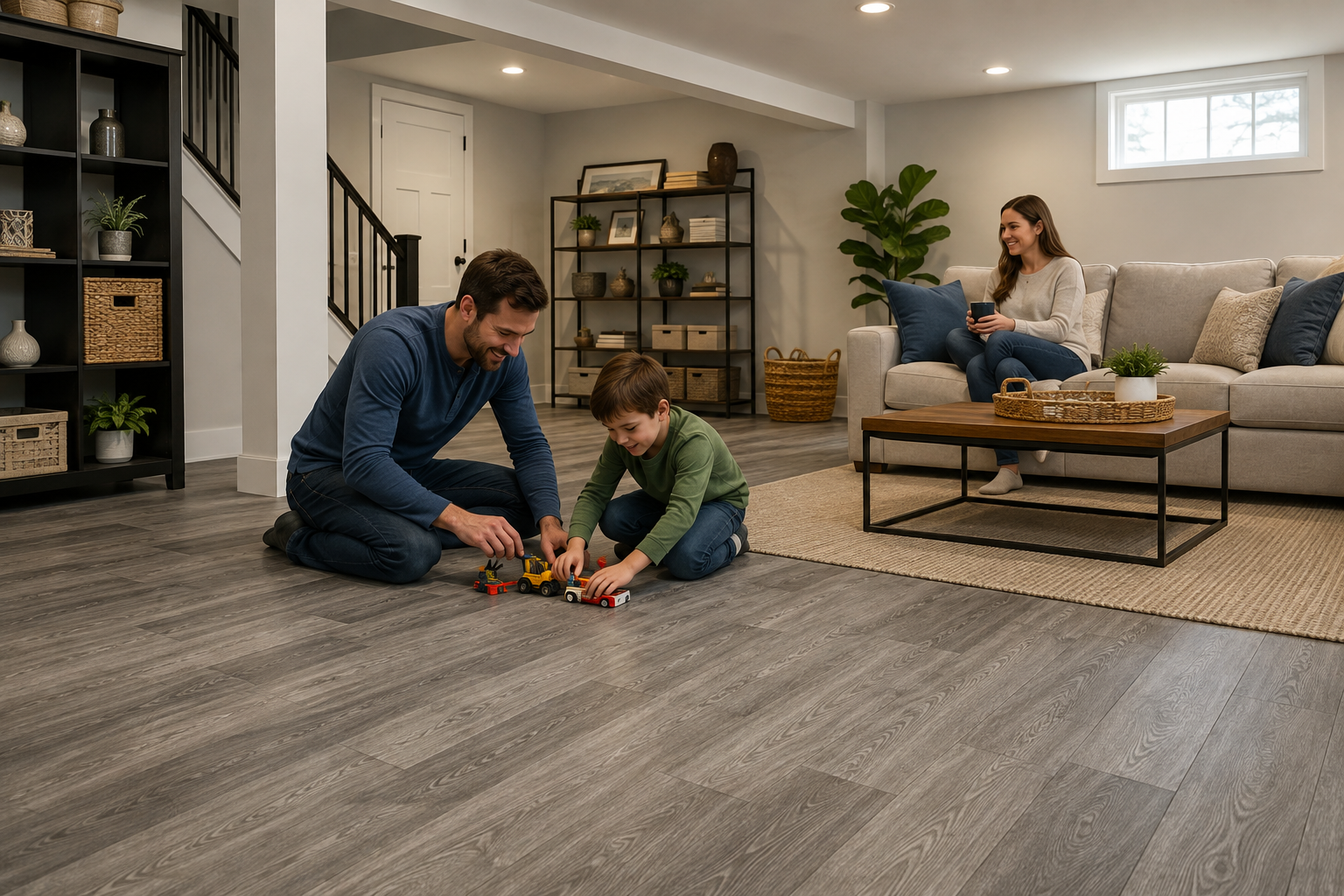
A finished basement can become one of the most useful spaces in a home. It might serve as a family room, playroom, home gym, hobby area, guest space, or simply a cleaner and more comfortable place for storage. In the Tennessee Valley, however, basement flooring needs to be chosen with moisture in mind from the beginning.
Water can reach a basement in several ways. Rainwater may collect around the foundation, plumbing can leak, indoor humidity can rise, and moisture can move through or collect on a concrete slab. That does not mean every basement has a moisture problem, but it does mean the flooring decision deserves more thought than simply choosing a style that looks good upstairs.
For more than 40 years, One on One Flooring and Design has helped homeowners in Hazel Green, Huntsville, and across the Tennessee Valley select flooring for the way their homes are actually used. In a basement, that means balancing appearance, comfort, durability, cleaning needs, and the conditions beneath the finished floor.
Vinyl is often a strong option because many current products are designed to handle everyday spills and moisture exposure better than moisture-sensitive materials. Still, “waterproof flooring” does not mean a basement can ignore leaks, seepage, or a damp concrete slab. The best result starts with a dry, properly prepared space and a vinyl product approved for the specific installation.
Why Basement Flooring Starts With Moisture Control
Before comparing colors, plank widths, or wood-look patterns, look at the basement itself. Flooring performs best when the space underneath it is ready for installation.
The U.S. Environmental Protection Agency advises homeowners to check basements for leaks and other signs of moisture before converting or remodeling them. Water may enter from outside, seep through basement floors, or come from plumbing and other indoor sources. EPA guidance emphasizes correcting those moisture problems before finishing the space.
Check for Obvious Signs of Water
Walk through the basement after a period of rain and look closely around foundation walls, windows, plumbing lines, floor drains, utility areas, and the edges of the slab. Watch for:
Damp spots or visible water
Discoloration on concrete or walls
A persistent musty smell
Peeling paint or coatings
White, powdery mineral deposits on masonry
Condensation on pipes or other cool surfaces
Repeated wet areas after storms
Signs that water has entered around doors or windows
A dry-looking floor on one afternoon does not always tell the whole story. If the basement has a history of water intrusion, it is worth understanding where the moisture originates before covering the concrete.
Fix the Cause Before Covering the Floor
Sometimes the solution is relatively straightforward, such as extending a downspout farther from the foundation, clearing gutters, correcting a small plumbing leak, or improving drainage around the home. Other situations may need professional waterproofing, foundation work, plumbing repairs, or drainage improvements.
Flooring is the finished surface, not a substitute for moisture control. Covering an active water problem can make the issue harder to see while moisture continues affecting materials beneath or around the floor.
That is especially important when turning a basement into a regularly occupied room. A beautiful floor works best when it is part of a well-prepared, dry space.
Why Vinyl Can Be a Practical Basement Choice
Basement flooring has to do more than look attractive. It may need to handle children, pets, workout equipment, storage bins, muddy shoes, spills, and changes in humidity. Vinyl offers several practical advantages for these everyday demands.
Many modern vinyl products are built with moisture resistance in mind. Some luxury vinyl and rigid-core collections are marketed as waterproof, meaning the flooring material itself is designed not to swell, buckle, or lose integrity when exposed to water under the conditions stated by the manufacturer. That makes these products appealing for below-grade rooms where occasional spills or moisture concerns are part of the planning process.
There is an important distinction, though: waterproof flooring is not the same as a waterproof basement. Manufacturer guidance notes that moisture or flooding can still affect the subfloor or substrate underneath a waterproof vinyl product. In other words, the surface may tolerate water while the installation below it still needs proper moisture management.
Comfortable Style Without a “Basement” Look
One reason homeowners choose vinyl is design flexibility. A basement does not have to feel like a utility space.
Vinyl is available in visuals that resemble hardwood, stone, and tile, allowing homeowners to create a warmer family room, a clean home office, a polished entertainment space, or a practical workout area. Wood-look designs are especially useful when you want the appearance of planks but prefer a flooring category suited to the realities of a below-grade room.
Easy Everyday Maintenance
Basements can collect dust and debris quickly, especially when they connect to garages, workshops, yards, or storage areas. Vinyl is generally straightforward to sweep or vacuum, and many products can be cleaned with manufacturer-approved damp-cleaning methods.
That makes it a practical fit for households that want a basement they can actually use rather than a room that feels too delicate for everyday life.
Vinyl Flooring Options to Consider for a Basement
“Vinyl” covers more than one type of flooring. The best choice depends on how you plan to use the room, the condition of the concrete, the product’s installation requirements, and the level of moisture exposure the manufacturer allows.
Homeowners exploring vinyl flooring can compare different looks and formats while keeping basement performance requirements at the center of the decision.
Vinyl Sheet
Sheet vinyl comes in large, continuous sections, which means there are fewer seams across the finished floor than with individual planks or tiles. Depending on the product and installation method, that can make it appealing for areas where easy cleaning and broad surface coverage are priorities.
It is available in a wide range of patterns, including stone, tile, and wood-inspired visuals. Sheet vinyl can work well in multipurpose basements, laundry areas, craft rooms, and other spaces where practicality matters.
Installation preparation is still important. The concrete needs to meet the product manufacturer’s requirements for smoothness, moisture, condition, and any approved underlayment or adhesive system.
Vinyl Plank and Tile Formats
Plank and tile formats make it easier to create a more residential look in a finished basement. Wood-look planks can visually connect the basement with living spaces elsewhere in the home, while stone- or tile-look products can suit bars, game rooms, exercise areas, or utility spaces.
Some products use click-lock construction, while others are glued down. These systems are not interchangeable, and below-grade approval can vary by product.
Rigid-Core Vinyl
Rigid-core flooring is another popular format for spaces where durability and dimensional stability matter. Many rigid-core products combine a decorative vinyl surface with a more substantial core and a click-together installation.
Depending on the specific collection, this construction can provide a solid feel underfoot and strong resistance to everyday wear. Some products also include an attached pad, though homeowners still need to follow the manufacturer’s requirements for moisture protection and underlayment.
The important point is to shop by product specifications, not category name alone. A floor that is suitable for one basement may not be approved for another installation. Confirm below-grade use, moisture limits, subfloor requirements, and warranty conditions before making the final selection.
Pay Attention to the Concrete Slab
A concrete basement floor may look solid and dry while still transmitting moisture. That is why preparation and testing matter.
Industry installation guidance for resilient flooring notes that on-grade and below-grade concrete can be affected by moisture from the ground. Proper vapor-retarding systems and appropriate moisture evaluation can be important to the long-term performance of the finished flooring.
Moisture Testing Is More Useful Than Guessing
Touching the slab or checking whether it looks damp is not a reliable moisture test. A professional installer can evaluate the substrate using methods appropriate to the flooring system being considered.
Different manufacturers specify different acceptable moisture limits and testing procedures. The correct threshold depends on the product, adhesive, installation system, and concrete conditions.
That is why broad statements such as “vinyl can go over any concrete” are misleading. Some products tolerate challenging environments better than others, but the installation still needs to meet the manufacturer’s written requirements.
A Vapor Retarder May Be Part of the System
For below-grade concrete, moisture coming from the ground can be an ongoing source rather than a one-time spill. Armstrong installation guidance notes the importance of an intact vapor retarder beneath on- or below-grade concrete for resilient flooring installations.
In an existing basement, you may not know exactly how the original slab was constructed. That does not automatically prevent a flooring update, but it makes assessment more valuable. Depending on the product and conditions, an approved moisture-mitigation system, underlayment, vapor barrier, or other preparation may be recommended.
Do not add plastic sheeting or another barrier simply because it seems like extra protection. Flooring systems are designed to work in specific combinations, and using an unapproved layer can create installation or warranty problems.
Make the Slab Smooth and Sound
Moisture is not the only concern. Concrete also needs to be sufficiently flat, clean, stable, and free of contaminants that interfere with the chosen installation method.
Cracks, high spots, low areas, old adhesives, coatings, or damaged concrete may need attention first. Good preparation helps the finished vinyl sit properly and look more consistent across the room.
Match the Vinyl to How You Use the Basement
A basement family room and a basement workshop do not have the same flooring priorities. Think about daily life in the space before focusing on the final look.
For Family Rooms and Entertainment Spaces
If the basement is becoming an extension of the main living area, comfort and appearance may lead the decision. Wood-look planks can create a warm, finished feel, while resilient construction makes routine cleanup easier after movie nights, snacks, pets, and gatherings.
Consider the furniture layout, traffic patterns, and how much natural light reaches the room. A lighter floor can help a basement feel brighter, while warmer tones can make a large open room feel more inviting.
For Playrooms and Pet Areas
Families with children or pets may value easy cleanup and a surface that stands up well to regular activity. Look closely at wear-layer information, scratch and stain resistance, manufacturer cleaning instructions, and warranty coverage.
Waterproof product claims can be useful for common spills, but pet accidents and drink spills still need prompt cleaning. Keeping moisture from sitting on or around the floor also protects trim, walls, and other materials that may not be waterproof.
For Home Gyms
Exercise spaces create different demands. Equipment can be heavy, and some machines concentrate weight in small areas. Check the flooring manufacturer’s guidance for rolling loads, heavy equipment, rubber-backed mats, and potential staining from certain materials.
A protective mat approved for the floor can help, but not every mat backing is compatible with every vinyl finish.
For Laundry and Utility Areas
Basement laundry rooms benefit from flooring that is easy to clean, but washing-machine leaks are different from ordinary splashes. Make sure supply hoses, drains, and appliance connections are in good condition. If a major leak occurs, the surrounding structure and substrate may need attention even when the flooring material itself is marketed as waterproof.
Keep Basement Humidity Under Control After Installation
Choosing moisture-resistant flooring is only one part of creating a comfortable basement. Indoor humidity still matters for the room, walls, furnishings, stored belongings, and air quality.
EPA guidance recommends keeping indoor relative humidity below 60% and ideally between 30% and 50% when possible. It also recommends addressing leaks promptly and drying damp or wet materials within roughly 24 to 48 hours to reduce the chance of mold growth.
Use a Hygrometer
A basic humidity meter can show you what is happening in the basement instead of relying on whether the air feels damp.
Check it at different times of year, especially after periods of heavy rain or during humid summer weather. If relative humidity regularly runs high, a properly sized dehumidifier may help.
Watch for Condensation
Basements often contain cool pipes, ductwork, utility equipment, and concrete surfaces. When humid air meets a cooler surface, condensation can form.
Recurring condensation is worth addressing. Insulation, ventilation, dehumidification, or HVAC adjustments may be appropriate depending on where the moisture is forming.
Clean According to the Flooring Manufacturer
Vinyl is generally easy to maintain, but cleaning directions still vary between products.
Sweep or vacuum loose grit before damp cleaning so particles are not dragged across the surface. Use products recommended for the specific floor, and avoid assuming that a strong cleaner is automatically a better cleaner.
Wipe spills promptly, especially around walls, baseboards, cabinets, or other materials that may be more sensitive to water than the vinyl itself.
Know When a Basement Needs More Than New Flooring
There is a major difference between choosing a floor for a basement that occasionally feels humid and installing over an active water problem.
If you see recurring seepage, standing water, widespread dampness, persistent mold growth, or significant foundation concerns, address those conditions before proceeding with a cosmetic flooring update. The EPA specifically recommends correcting basement moisture problems before converting the area into living space.
Signs that deserve closer attention include:
Water entering after heavy rain
A sump system that cannot keep up
Recurring dampness at the slab edges
Persistent musty odors
Visible mold or repeated biological growth
Efflorescence or recurring mineral deposits
Plumbing or appliance leaks
Condensation that returns despite routine humidity control
Flooring that releases, bubbles, shifts, or changes after installation
A flooring specialist can evaluate the floor surface and product requirements, but water intrusion may also call for a waterproofing contractor, plumber, HVAC professional, drainage specialist, or foundation expert.
Knowing when to involve the right professional protects the investment you are making in the finished room.
Create a Basement That Feels Like Part of Your Home
The best basement flooring decision is not simply “Which material is waterproof?” A better question is: “Which flooring system fits this basement, this concrete slab, and the way we plan to use the room?”
Vinyl can be a practical answer for many Tennessee Valley homes because it offers a broad range of styles, straightforward maintenance, and products designed for moisture-prone spaces. The strongest results come from pairing the right product with good moisture control and careful installation preparation.
Start by checking for leaks and seepage. Understand the condition of the concrete. Confirm that the specific vinyl product is approved for below-grade use. Follow its moisture-testing, underlayment, adhesive, and installation requirements. Then choose a style that helps the room feel comfortable and connected to the rest of your home.
Whether you are turning a basement into a family room, gym, play area, guest space, or simply a more polished multipurpose room, thoughtful flooring can help transform an underused level into space your household enjoys every day.
If you are planning new basement floors in Hazel Green, Huntsville, or elsewhere in the Tennessee Valley, get in touch with One on One Flooring and Design for personalized guidance on selecting an option that fits your space, style, and everyday needs.


